
Oconee Parole and Probation
Parole follows a Georgia prison sentence. The State Board of Pardons and Paroles decides whether an eligible state inmate may serve part of the sentence in the community. Probation comes from a court sentence. It may begin without prison, or it may follow confinement as part of a split sentence. The Georgia Department of Community Supervision, or DCS, handles field supervision for both felony probation and parole.
A person who bonds out of Oconee County Jail is not automatically on either form of supervision. The criminal case may still be pending. Likewise, someone who finishes a county sentence may leave without DCS supervision. A state prisoner released on parole normally has both a GDC actual release record and a parole supervision record. These sources answer different questions.
| Point | Parole | Probation |
|---|---|---|
| Who authorizes it | Georgia State Board of Pardons and Paroles | Sentencing court |
| What comes first | State prison custody | A probated or split sentence |
| Field agency | Georgia DCS | Georgia DCS for felony cases |
| Best public proof | Parolee Database and GDC release status | Court sentencing order and DCS confirmation |
- Parole
- Conditional community release before a state prison sentence fully expires.
- Probation
- Court-ordered supervision in the community under stated terms.
- Discharge
- The formal end of custody or supervision.
- Split sentence
- A sentence combining confinement with a later probation term.
Verify Oconee Release Supervision
Begin by deciding whether the person left the county jail, a Georgia prison, or neither. The Oconee JailTracker record can confirm a recent county release, but it does not prove parole. For a prior state prisoner, the GDC Find an Offender search can show an actual release date and inactive status. Then use the Parole Board's public tools to check present parole information.
- Search GDC by name, GDC ID, or case number and match the identity carefully.
- Read current status and actual release date. “Currently serving” means the state release has not occurred.
- Use the Georgia Parolee Database for parole begin and end dates, office, office number, and primary offense when available.
- For probation, review the Oconee court sentencing order and ask DCS which field office holds the case.
- Confirm time-sensitive details with the responsible agency because residence, case assignment, and supervision status can change.
The Inmate TPM Lookup is for an incarcerated person who may receive a tentative parole month. A TPM is not proof of release. It can be changed before the person leaves custody. The broader released-person search and county release-record path are covered on the Oconee County released inmates home page.
Oconee Parole Records Fields
The parolee search is the strongest public post-release source when the person actually left state prison on parole. Available results may include the parole begin date, parole end date, office, office phone, primary offense, and parole or pardon status. An absent result has several possible meanings. The person may be on probation, may have finished supervision, may not be publicly returned, or may never have been paroled.
GDC and parole records should be read together. GDC's actual release date confirms departure from state custody. The parolee result addresses the conditional period after that departure. A court docket can add the sentencing basis, especially for a split sentence. Georgia VINE supplies custody-change notifications but is not a supervision archive.
The Parole Board homepage provides the TPM and parolee search entry points and lists a Parole and Corrections Call Center at (404) 656-4661 for consideration and eligibility questions. No fee is required for parole consideration. Treat any demand for such payment as suspect.
Oconee DCS Athens Office
Oconee County's local field-supervision route is the DCS Athens Field Office. It serves Clarke and Oconee counties and the Western Judicial Circuit. DCS assigns supervision based on where a person resides, so the office serving an Oconee conviction may change when that person lives elsewhere. The Watkinsville jail and courthouse are not the routine reporting office for state felony supervision.
171 Old Epps Bridge Road
Athens, GA 30606
Coverage: Clarke, Oconee, and the Western Judicial Circuit
The DCS field-office directory is the source for current office routing. Its listing is also the right place to recheck contact details before a visit. Field supervision covers parole, felony probation, reprieve, and split-sentence cases within DCS authority.
The matched DCS directory image shows the Athens listing used for Oconee County release supervision.
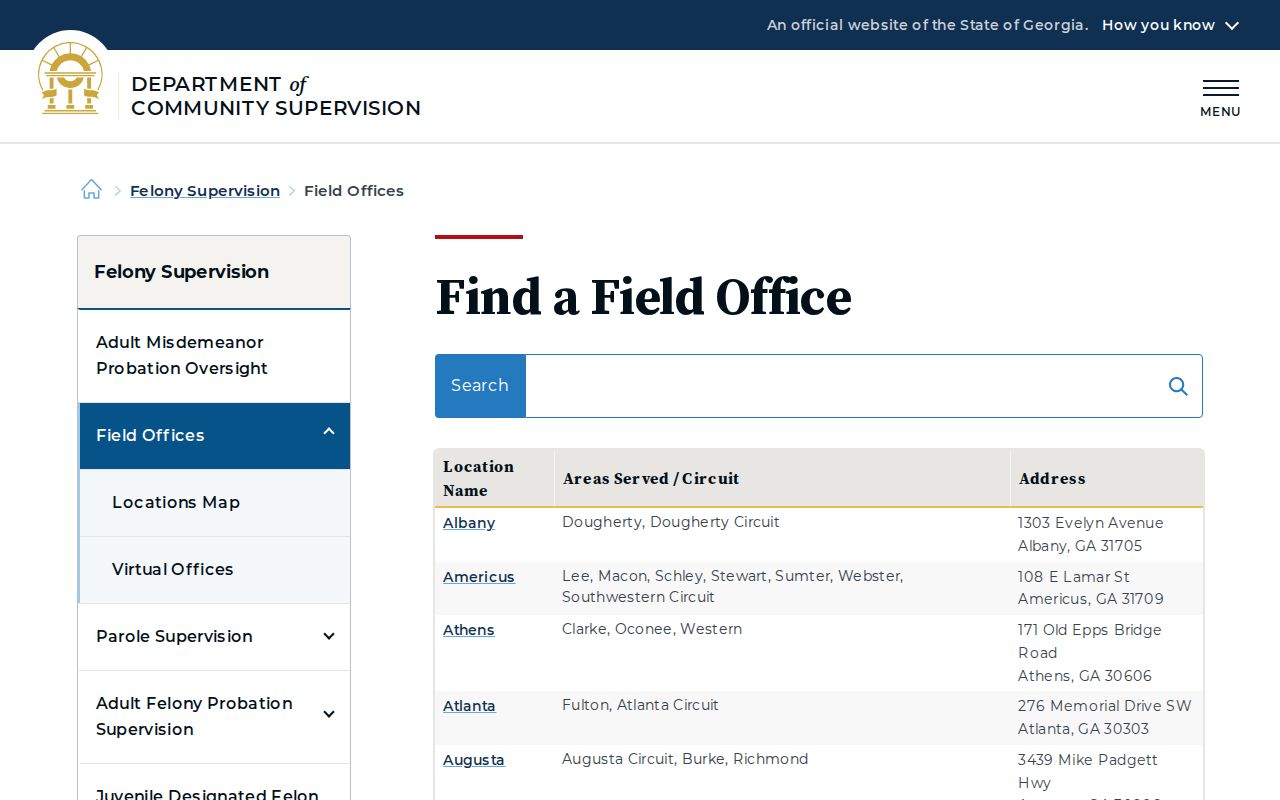
That office listing connects a statewide supervision record to the local office that serves Oconee residents.
Oconee Parole Decision Process
Georgia does not treat monthly Board operations meetings as individual public parole hearings. Public notices address agency policy and operations, while offender decisions are made through the Board's case process. For a person still incarcerated, the TPM Lookup reports tentative parole information. For a released parolee, use the parolee database instead.
Most parole-eligible inmates may become eligible after one-third of a sentence, but exclusions matter. Serious violent felony restrictions appear in O.C.G.A. § 17-10-6.1, while the general eligibility law is O.C.G.A. § 42-9-45. A TPM may be postponed or canceled after misconduct or failure to complete a required program. It is a planning month, not an actual release date.
The Board's parole process explanation shows how eligibility and review differ from release. A denial may lead to later reconsideration. For life-sentence cases, a grant or denial follows different review rules. None of those outcomes should be inferred from a missing jail roster entry.
Oconee Violations and Warrants
An absconder is a person alleged to have stopped reporting or otherwise left supervision without authorization. A violation does not automatically prove a new arrest, and a jail roster does not show the full supervision history. The research found no Oconee Sheriff absconder list tied to released inmates. Parole concerns should go through the Parole Board or DCS. Local warrant questions should be checked through court docket activity and sheriff records.
Conditions vary by order and case. Common high-level requirements may address reporting, approved residence, travel, programs, fees, or conduct, but the controlling terms are the person's written conditions. A violation can prompt administrative review, a warrant, court action, or return to custody. Only the supervising agency and court record can show the actual action.
Supervision ends by formal discharge, expiration, court action, or another authorized outcome. The parole end date is useful, yet current agency confirmation is safer when timing matters. A release date and a discharge date are not interchangeable.
Note: A current warrant may lead to new custody, but it does not erase or disprove the earlier Oconee County release.
Property After Oconee Release
The Oconee inmate-services systems explain why account and communication details often sit outside a release record. Before release, JailATM may hold deposit or gift-pack activity, a lobby kiosk may accept funds, and Paytel supports calls. Those service records do not establish the legal reason for release or the terms of supervision.
Questions about property, an account balance, or jail communications should be directed to Oconee Jail Operations rather than the Athens DCS office. DCS handles community supervision. The court keeps the sentencing and disposition record. The jail remains the source for custody property and account logistics. Keeping those roles separate prevents a practical post-release issue from being sent to the wrong agency.
The Oconee County inmate-services page identifies the systems used while a person is confined. It does not promise how or when funds are settled after release, so case-specific questions require jail confirmation.
Oconee Supervision Record Conflicts
Conflicting dates usually reflect different events. The Oconee jail release date marks the end of a local booking. A GDC actual release date marks the end of state prison custody. The parole begin date describes when community supervision starts, while a parole end date or discharge shows when that duty is set or recorded to end. Probation dates come from the sentencing court and may overlap another custody event.
Compare the name, case number, GDC ID, conviction county, and office before deciding that two records concern the same person. If the parolee database and GDC sheet disagree, ask the Parole Board about parole and GDC about custody. For probation, obtain the Oconee sentencing order and confirm the current assignment through DCS. A move may shift supervision away from Athens even when the conviction remains in Oconee County.
Keep a dated copy of the public result. Online status can change after discharge, a violation, transfer, or corrected assignment. The agency that created each field is the proper source for resolving it.